
Coronary Angiography in Ahmedabad — Heart Blockage Diagnosis at Apollo CVHF
If you have been experiencing chest pain, breathlessness, or abnormal results on an ECG or stress test, the next step your cardiologist will likely recommend is a coronary angiography. It is the definitive test for identifying whether there are blockages in the arteries that supply blood to your heart — and if so, exactly where they are and how severe they are.
Dr. Kulin Sheth performs coronary angiography at Apollo CVHF Heart Institute, Bodakdev, Ahmedabad — a leading cardiac catheterisation centre equipped with state-of-the-art imaging technology.
What Is Coronary Angiography?
Coronary angiography is a specialised X-ray imaging procedure that creates detailed pictures of the coronary arteries — the blood vessels that supply oxygen and nutrients to the heart muscle. It is considered the gold standard test for diagnosing coronary artery disease (CAD).
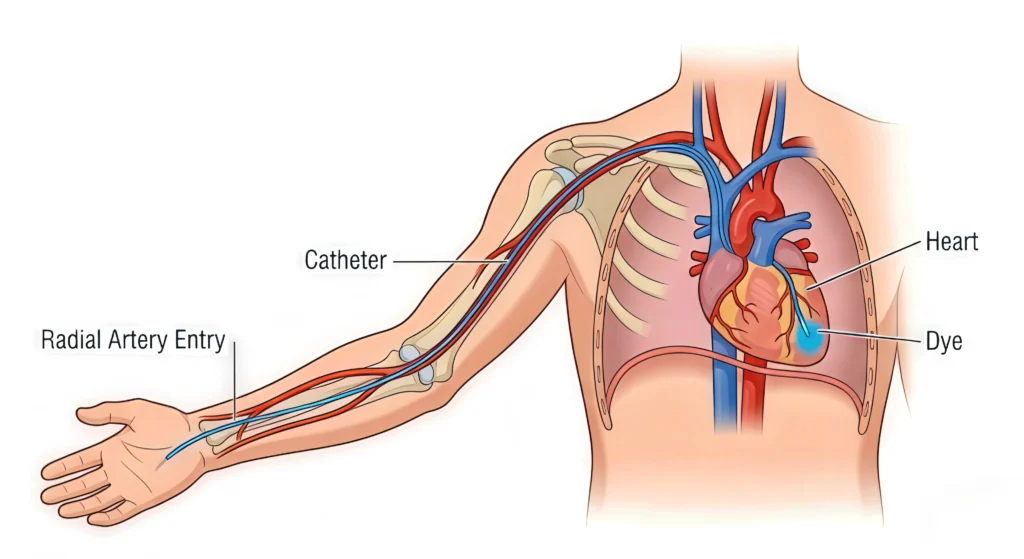
During the procedure, a thin, flexible tube called a catheter is guided through an artery in the wrist or groin up to the opening of the coronary arteries. A contrast dye is then injected through the catheter, making the arteries visible on X-ray. This produces clear images showing:
- Whether blockages are present in the coronary arteries
- The exact location, length, and severity of each blockage
- How many arteries are affected
- Whether the blockage is suitable for angioplasty (stenting) or requires bypass surgery
- The pattern of blood flow and collateral circulation
When Is Coronary Angiography Recommended?
- Chest pain (angina) that has not been adequately explained by non-invasive tests
- Abnormal or high-risk findings on a TMT (Treadmill Test) or stress echo
- A suspected or confirmed heart attack
- Unstable angina — chest pain at rest or worsening in frequency and severity
- An echocardiogram showing abnormal wall motion or reduced heart function without a clear cause
- Pre-operative cardiac evaluation before major surgery in high-risk patients
- Strong clinical suspicion of significant coronary artery disease based on symptoms and risk factors
Radial vs. Femoral Access — Which Route Is Used?
Dr. Kulin Sheth uses radial (wrist) access as the preferred and default route for coronary angiography. Radial access has several important advantages over the traditional femoral (groin) approach:
| Feature | Radial (Wrist) Access — Preferred |
|---|---|
|
Bleeding risk |
Significantly lower |
|
Ambulation after procedure |
Immediate — patient can walk right away |
|
Comfort |
Greater — no need to lie flat for hours |
|
Hospital stay |
Shorter in most cases |
|
Suitability |
Appropriate for the majority of patients |
Femoral (groin) access is used in specific situations — such as when the radial artery is anatomically unsuitable or when complex anatomy requires it. Dr. Sheth assesses the most appropriate access route for each individual patient.
What to Expect During and After the Procedure
Angiography is performed under local anaesthesia. You will be awake but relaxed and comfortable throughout. The procedure typically takes 20 to 40 minutes. When the contrast dye is injected, you may feel a brief sensation of warmth — this is completely normal and passes within seconds.
After the procedure, you will rest for a few hours while the access site is monitored. Most patients are discharged the same day. Recovery is quick — most patients resume normal activities within 24 to 48 hours.
If a significant blockage is found during angiography, Dr. Sheth may proceed directly to angioplasty in the same sitting, with the patient’s informed consent. This avoids the need for a separate procedure on a different day.
Location — Where Is Coronary Angiography Performed?

Apollo CVHF Heart Institute
- +91 7096 800 800
- Pakwan Cross Road, Sarkhej - Gandhinagar Hwy, opp. GNFC Tower, next to l.O.C petrol pump, Bodakdev, Ahmedabad, Gujarat 380059
- Angiography, Angioplasty, Pacemakers & Devices (ICD, CRT-D), Structural Heart Procedures (ASD/VSD/PDA Closure, TAVI), Complex Coronary Work (LMCA, Bifurcations, IVL, Rotablation)
- Open 24 hours
Dr. Kulin Sheth's Approach
Patients also appreciate that Dr. Sheth only recommends investigations that are genuinely needed. There are no unnecessary tests, no unnecessary procedures, and no unnecessary alarm.
Dr. Sheth is known for a calm, thorough, and patient-centred consultation style. He takes time to listen, never rushes through an appointment, and explains findings clearly so that patients leave with a genuine understanding of their heart health and what needs to be done — if anything.
Get a Definitive Answer About Your Heart
FAQs
No. The procedure is performed under local anaesthesia. You may feel mild pressure at the access site and a brief warm sensation from the dye injection, but the procedure itself is not painful.
No. Angiography is a minimally invasive catheter-based procedure. A thin tube is guided through an artery in the wrist or groin — no cuts, stitches, or general anaesthesia are involved in the standard procedure.
Most patients undergoing routine diagnostic angiography are discharged the same day. If angioplasty is performed in the same sitting, a stay of 24 to 48 hours is typically recommended.
Coronary angiography is a very safe procedure. Minor risks include bruising or discomfort at the access site. Serious complications are rare and are minimised by operator experience and careful patient selection. Dr. Sheth will discuss the specific risks relevant to your case before proceeding.
Yes. If a significant blockage is identified during angiography, Dr. Sheth may proceed directly to angioplasty in the same session with the patient’s consent — eliminating the need for a second procedure.