
Heart Hole Surgery in Ahmedabad: ASD, VSD & PDA Closure Without Open-Heart Surgery
Being told your child or you has a hole in the heart is one of the most frightening things a family can hear. The first questions are almost always the same: Does it need surgery? Will it require opening the chest? Is it dangerous?
The reassuring answer for many patients today is that most heart holes can be closed without open-heart surgery using a minimally invasive catheter-based procedure that requires no chest incision, no heart-lung machine, and typically allows discharge within 1 to 2 days.
Dr. Kulin Sheth performs catheter-based heart hole closure at Apollo CVHF Heart Institute, Bodakdev, Ahmedabad for ASD, VSD, and PDA in both children and adults.
What Is a Heart Hole?
A heart hole is a common term for a congenital heart defect, a structural abnormality of the heart that is present from birth. These defects involve openings or communications between the heart chambers or blood vessels that should normally be separate, causing abnormal blood flow within the heart. Early diagnosis by a heart specialist is important for timely and effective congenital heart disease treatment.
The three most common types of heart hole defects that can be treated with a minimally invasive catheter procedure are:
ASD Atrial Septal Defect (Hole Between the Upper Chambers)
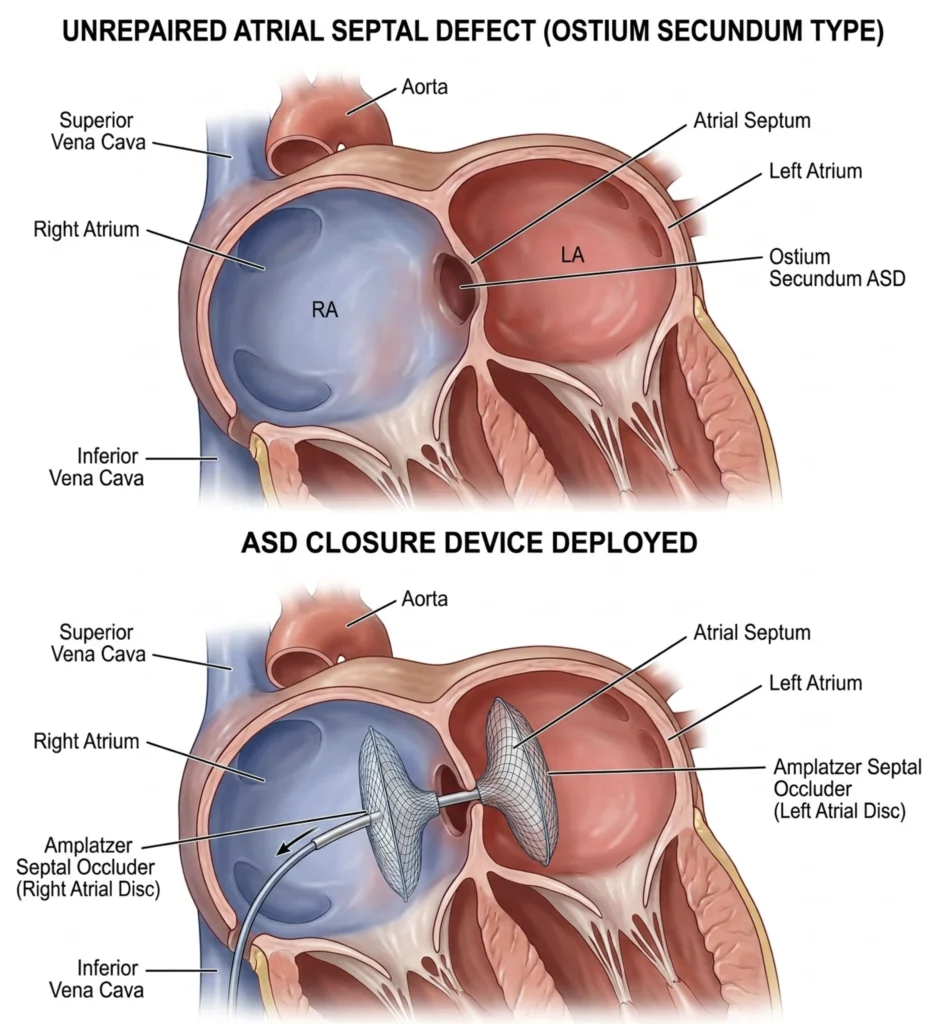
An ASD is a hole in the wall (septum) between the two upper chambers of the heart, the right and left atria. This allows blood to flow from one side to the other, forcing the right side of the heart to handle extra blood volume. Over time, this causes the right heart to enlarge and, if untreated, can lead to pulmonary hypertension elevated pressure in the lung arteries) and heart failure.
ASD is one of the most common congenital heart defects and is frequently detected in adulthood, sometimes incidentally on an echocardiogram performed for another reason.
VSD: Ventricular Septal Defect (Hole Between the Lower Chambers)
A VSD is a hole in the wall between the two lower chambers, the right and left ventricles. Blood flows from the high-pressure left ventricle through the hole into the right ventricle, increasing blood flow to the lungs. Small VSDs may close spontaneously in childhood. Larger VSDs cause significant strain on the heart and lungs and require closure.
PDA : Patent Ductus Arteriosus
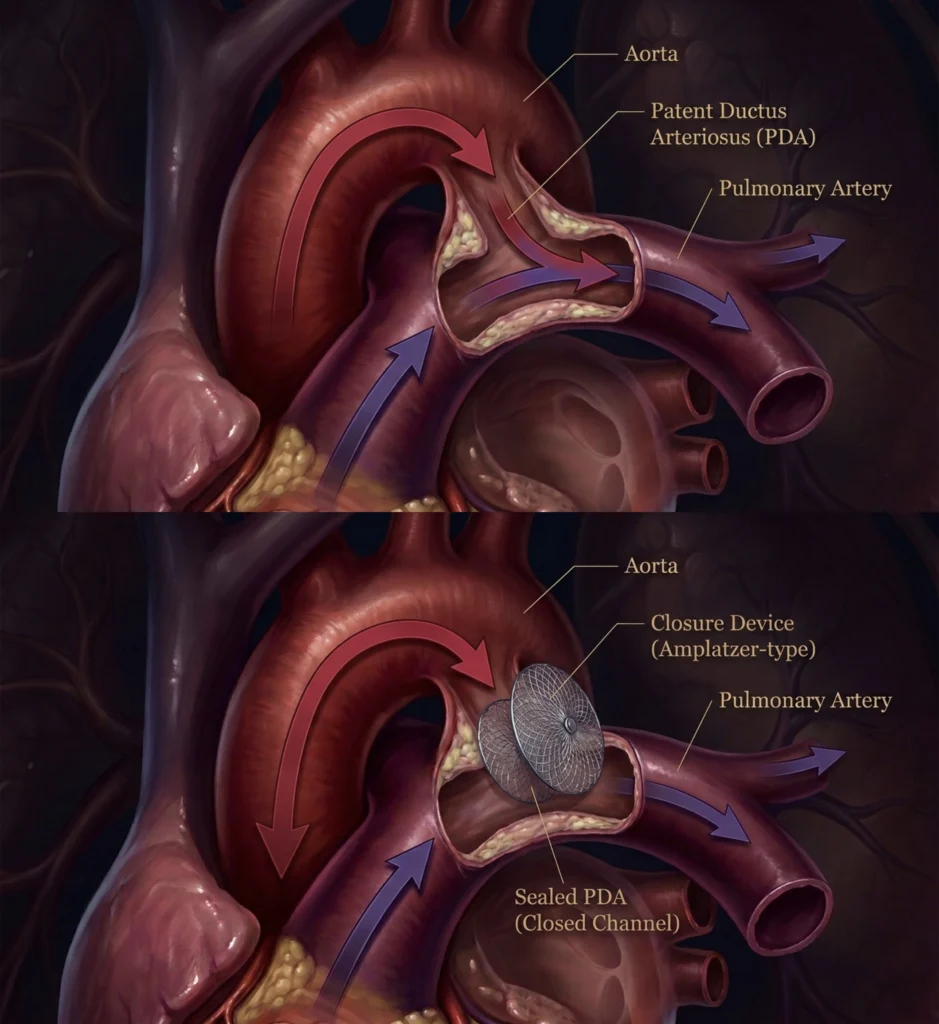
Before birth, a blood vessel called the ductus arteriosus connects the aorta (the main artery from the heart to the body) and the pulmonary artery (the artery to the lungs). This vessel normally closes within days of birth. When it fails to close, a condition called Patent Ductus Arteriosus allows blood to flow back from the aorta into the pulmonary circulation, increasing the workload on the heart and lungs.
How Is Heart Hole Closure Performed Without Surgery?
Catheter-based heart hole closure is performed under general anaesthesia or conscious sedation, guided by real-time X-ray and echocardiographic imaging. A thin catheter is inserted through a vein in the groin; no incision in the chest is required.
A specially designed occluder device, a self-expanding, double-disc implant made from nitinol (a biocompatible metal alloy), is compressed into the catheter and guided to the site of the defect. Once positioned precisely across the hole under echo and X-ray guidance, the device is released. It expands on both sides of the defect, effectively sealing it like a plug.
Over the following weeks and months, the heart’s own tissue grows over the device, fully incorporating it into the wall of the heart and permanently closing the defect.
Advantages of Catheter-Based Closure Over Open-Heart Surgery
| Feature | Catheter-Based Closure |
|---|---|
|
Chest incision |
None only a small puncture in the groin |
|
Heart-lung machine |
Not required |
|
Anaesthesia |
General anaesthesia or sedation |
|
Hospital stay |
Typically 1 to 2 days |
|
Recovery time |
1 to 2 weeks in most cases |
|
Scar |
Minimal – small puncture site only |
|
Effectiveness |
Comparable to open surgery for suitable defects |
Who Is a Candidate for Catheter-Based Closure?
- Children and adults with a haemodynamically significant ASD, VSD, or PDA causing symptoms or evidence of right heart enlargement or volume overload
- Patients with a defect that has been observed and is now considered large enough to require closure
- Adults diagnosed with a congenital defect that was not closed in childhood
- Patients with unexplained breathlessness, reduced exercise tolerance, or palpitations found to have a significant shunt defect
- Patients with a cryptogenic stroke where a paradoxical embolism through a cardiac defect is suspected
Location: Where Is Heart Hole Closure Performed?
Apollo CVHF Heart Hospital
- +91 7096 800 800
- Pakwan Cross Road, Sarkhej - Gandhinagar Hwy, opp. GNFC Tower, next to l.O.C petrol pump, Bodakdev, Ahmedabad, Gujarat 380059
- Angiography, Angioplasty, Pacemakers & Devices (ICD, CRT-D), Structural Heart Procedures (ASD/VSD/PDA Closure, TAVI), Complex Coronary Work (LMCA, Bifurcations, IVL, Rotablation)
- Open 24 hours
Dr. Kulin Sheth's Approach
Dr. Sheth is known for a calm, thorough, and patient-centred consultation style. He takes time to listen, never rushes through an appointment, and explains findings clearly so that patients leave with a genuine understanding of their heart health and what needs to be done if anything.
Patients also appreciate that Dr. Sheth only recommends investigations that are genuinely needed. There are no unnecessary tests, no unnecessary procedures, and no unnecessary alarm.
A Heart Hole Doesn't Always Mean Open-Heart Surgery
Book a consultation with Dr. Kulin Sheth to understand your options.
Call or WhatsApp: +91 9725551563 | Sheth Heart Clinic, Bopal, Ahmedabad
FAQs
Dr. Kulin Sheth specializes in treating congenital heart defects—commonly referred to as “holes in the heart”—including:
ASD (Atrial Septal Defect): A hole in the wall (septum) separating the two upper chambers (atria).
VSD (Ventricular Septal Defect): A hole in the wall separating the two lower chambers (ventricles).
PDA (Patent Ductus Arteriosus): An unclosed fetal blood vessel near the heart that should close naturally shortly after birth.
PFO (Patent Foramen Ovale): A flap-like opening between the upper chambers that failed to seal properly after birth.
No. While large or complex defects may occasionally require traditional open-chest surgical repair, a significant portion of ASDs, PDAs, and select VSDs can be treated safely without surgery. As an interventional cardiologist, Dr. Kulin Sheth prioritizes percutaneous transcatheter device closure. This advanced, non-surgical method closes the hole using a specialized umbrella-like device delivered through a minor pin-hole puncture in the groin, completely avoiding a large chest incision.
The non-surgical closure is performed in a cardiac catheterization laboratory under local anesthesia or light sedation. Dr. Kulin Sheth inserts a thin, flexible tube (catheter) into a blood vessel in the groin and guides it up to the heart using real-time X-ray (fluoroscopy) and ultrasound imaging. A specialized closure device (occluder) is then passed through the catheter and deployed precisely across the hole. Once released, the device expands to seal the defect instantly.
Because the transcatheter approach avoids cutting through bone or muscle, recovery is highly accelerated compared to open-heart surgery. Patients typically stay in the hospital for 24 to 48 hours for routine observation and are discharged to return home. Normal, non-strenuous daily activities can be resumed within 3 to 5 days, though strenuous physical exertion and heavy lifting should be avoided for approximately one month.
Dr. Kulin Sheth provides comprehensive structural heart care, utilizing advanced diagnostic tools like transesophageal echocardiography (TEE) to precisely measure the size and rim tissue of the defect. This meticulous planning ensures highly precise device sizing and placement. His evidence-based clinical approach ensures that patients receive an honest, objective assessment regarding whether their condition is best managed via regular monitoring, non-surgical device closure, or surgical referral.
An echocardiogram is performed at 1 month, 6 months, and 1 year after the procedure to confirm complete closure and assess device position. Antiplatelet medication is prescribed for the first 6 months. After confirmed complete closure, most patients require no further intervention.