
Pacemaker Implantation in Ahmedabad Slow Heart Rate Treatment at Apollo CVHF
If your heart beats too slowly, causing dizziness, fainting, extreme fatigue, or breathlessness, a pacemaker may be the solution that helps restore your quality of life. A pacemaker implantation procedure involves placing a small implanted device that continuously monitors your heart rate and delivers a gentle electrical impulse whenever the natural heartbeat drops below a safe threshold. This advanced treatment is highly effective for patients with slow heart rhythm (bradycardia) and certain heart rhythm disorders.
Dr. Kulin Sheth, an experienced Interventional Cardiologist in Ahmedabad, performs pacemaker implantation in Ahmedabad at Apollo CVHF Heart Institute, Bodakdev, using the latest generation of pacing systems for both single-chamber and dual-chamber pacemakers to provide safe, reliable, and advanced cardiac care.
What Is a Pacemaker?
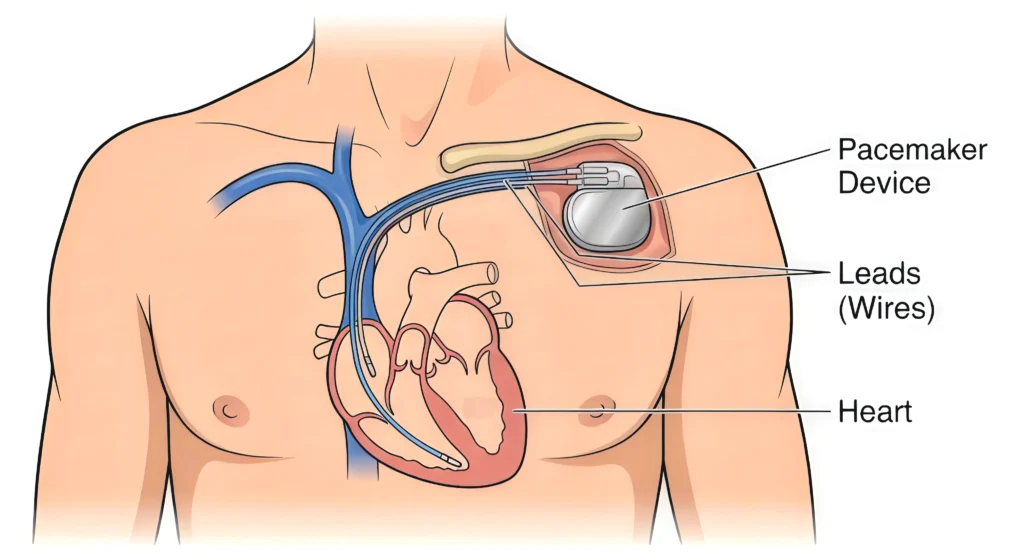
A permanent pacemaker is a small electronic device roughly the size of a large coin that is implanted beneath the skin just below the collarbone. It consists of a pulse generator (the device containing the battery and electronics) connected to one or more leads, thin, flexible wires that are threaded through a vein into the heart.
The pacemaker continuously monitors the heart’s own electrical activity. When the natural heart rate is adequate, the pacemaker simply watches and does nothing. When the rate drops too slowly or pauses, it delivers a small electrical impulse that triggers a heartbeat, maintaining a safe and comfortable heart rate.
When Is a Pacemaker Needed?
- Sick Sinus Syndrome : the heart's natural pacemaker (the sinus node) fires too slowly, too fast, or irregularly
- Heart Block (AV Block) : the electrical signal between the upper and lower chambers of the heart is delayed or blocked, causing the ventricles to beat too slowly, too fast, or irregularly
- Symptomatic Bradycardia: a persistently slow heart rate (typically below 40–50 beats per minute) causing dizziness, fainting, fatigue, or breathlessness
- Carotid Sinus Hypersensitivity: a condition causing fainting triggered by pressure on the neck
- Post-cardiac surgery or post-procedure bradycardia: when the heart rate does not recover adequately after a procedure or surgery
Types of Pacemakers
- Single-chamber pacemaker: one lead placed in either the right atrium or right ventricle, depending on the clinical indication
- Dual-chamber pacemaker: two leads, one in each chamber, allowing coordinated pacing that more closely mimics the heart's natural rhythm
- Rate-responsive pacemaker: adjusts the pacing rate automatically in response to physical activity, allowing the heart rate to increase appropriately during exercise
What to Expect The Procedure
Pacemaker implantation is performed under local anaesthesia with sedation. A small incision is made just below the collarbone, through which the lead or leads are guided through a vein into the heart under X-ray guidance. The pulse generator is placed in a small pocket created beneath the skin.
The procedure typically takes 60 to 90 minutes. Most patients are discharged within 24 to 48 hours. The implanted device is not visible from outside and is not felt by the patient in daily life in most cases. A follow-up device check is arranged shortly after discharge and then at regular intervals to monitor battery life and device function.
Location: Where Is Pacemaker Implantation Performed?

Apollo CVHF Heart Hospital
- +91 7096 800 800
- Pakwan Cross Road, Sarkhej - Gandhinagar Hwy, opp. GNFC Tower, next to l.O.C petrol pump, Bodakdev, Ahmedabad, Gujarat 380059
- Angiography, Angioplasty, Pacemakers & Devices (ICD, CRT-D), Structural Heart Procedures (ASD/VSD/PDA Closure, TAVI), Complex Coronary Work (LMCA, Bifurcations, IVL, Rotablation)
- Open 24 hours
Dr. Kulin Sheth's Approach
Dr. Sheth is known for a calm, thorough, and patient-centred consultation style. He takes time to listen, never rushes through an appointment, and explains findings clearly so that patients leave with a genuine understanding of their heart health and what needs to be done, if anything.
Patients also appreciate that Dr. Sheth only recommends investigations that are genuinely needed. There are no unnecessary tests, no unnecessary procedures, and no unnecessary alarm.
Restore a Safe, Steady Heartbeat
FAQs
Dr. Kulin Sheth recommends a pacemaker to treat dangerous arrhythmias, specifically severe bradycardia (an abnormally slow heart rate) or complete heart block. A pacemaker monitors the heart’s electrical system and sends electrical impulses to ensure the heart beats at a normal rate, preventing critical symptoms such as frequent fainting (syncope), chronic fatigue, dizziness, and shortness of breath.
The procedure is a minimally invasive surgery performed in a cardiac catheterization lab under local anesthesia and conscious sedation. Dr. Kulin Sheth makes a small incision just below the collarbone to pocket the pulse generator (battery). He then guides thin, insulated wires (leads) through a major vein directly into the heart chambers using real-time X-ray (fluoroscopic) guidance. The entire process takes approximately one to two hours.
Depending on the specific cardiac conduction disorder, Dr. Kulin Sheth implants single-chamber, dual-chamber, or biventricular pacemakers (Cardiac Resynchronization Therapy or CRT). For eligible patients seeking advanced technology, he also evaluates candidates for modern leadless pacemakers, which are miniaturized devices implanted directly into the right ventricle without the need for traditional wires or surgical pockets.
Patients typically require an overnight hospital stay for continuous cardiac monitoring and device programming. Following discharge, routine daily activities can be resumed within a few days. However, Dr. Kulin Sheth strictly advises patients to avoid heavy lifting and excessive overhead arm movements on the implanted side for four to six weeks to allow the pacemaker leads to permanently secure themselves to the heart muscle.
Modern pacemakers are heavily shielded against daily electromagnetic interference. Patients can safely use standard household appliances, including microwaves. However, mobile phones should be kept at least six inches away from the pacemaker generator and held to the opposite ear. Dr. Kulin Sheth provides comprehensive post-operative guidelines, including protocols for carrying a pacemaker identification card for airport security clearance and guidelines regarding MRI-conditional pacemaker safety.