
Coronary Angioplasty in Ahmedabad Heart Blockage Treatment at Apollo CVHF
Coronary angioplasty , also called stenting or PCI (Percutaneous Coronary Intervention), is a procedure that opens blocked or narrowed coronary arteries and restores blood flow to the heart muscle. It is one of the most commonly performed cardiac procedures in the world and is the standard emergency treatment for heart attacks.
Dr. Kulin Sheth performs coronary angioplasty at Apollo CVHF Heart Institute, Bodakdev, Ahmedabad, including both routine and highly complex cases requiring advanced techniques and technology.
What Is Coronary Angioplasty?
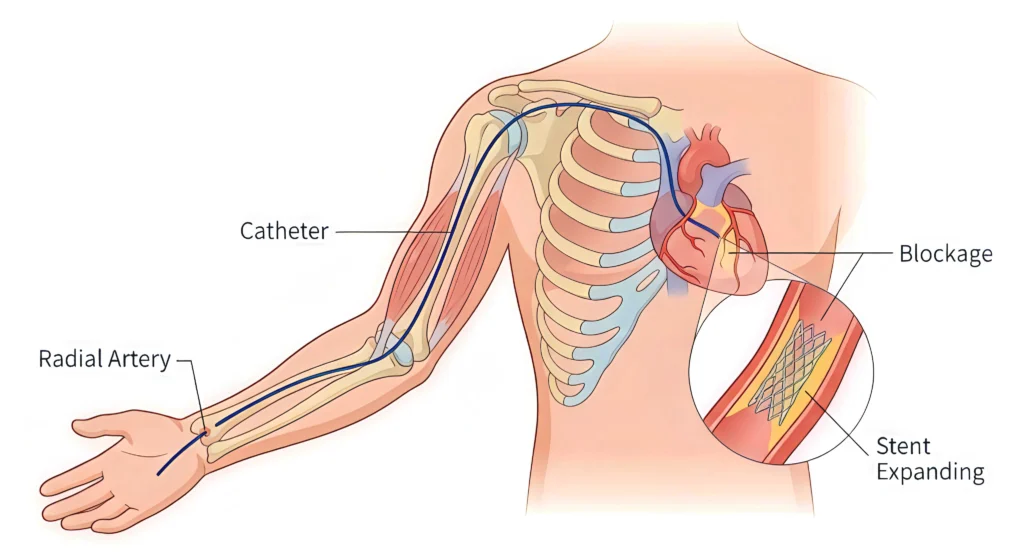
During angioplasty, a thin catheter with a small balloon at its tip is guided through an artery in the wrist or groin to the site of the blockage in the coronary artery. The balloon is inflated to widen the narrowed artery, and a stent, a small metal mesh tube, is deployed to keep the artery open permanently.
Modern stents are drug-eluting; they release a medication over time that prevents the artery from narrowing again, significantly reducing the long-term risk of re-blockage.
When Is Angioplasty Recommended?
- A significant coronary artery blockage identified on angiography that is causing symptoms
- An acute heart attack (STEMI or NSTEMI) requiring emergency restoration of blood flow
- Chest pain (angina) that persists despite optimal medical therapy
- Non-invasive tests showing evidence of ischaemia, insufficient blood supply to the heart
- A blockage posing a significant risk of future heart attack based on its anatomy and location
Types of Angioplasty Performed by Dr. Sheth
- Standard coronary angioplasty : with drug-eluting stents for routine single or multi-vessel blockages
- Primary PCI (Emergency Angioplasty): the life-saving procedure performed during a heart attack to restore blood flow as rapidly as possible
- Multi-vessel PCI treatment of blockages in more than one coronary artery in a staged or single-sitting approach
- Post-CABG graft intervention: treating blockages in bypass grafts after previous bypass surgery
What Happens After Angioplasty?
After the procedure, patients are observed for 24 to 48 hours. You will be prescribed dual antiplatelet therapy, a combination of two blood-thinning medications that must be taken consistently for a prescribed period (usually 6 to 12 months) to prevent stent thrombosis (clotting inside the stent).
Regular follow-up consultations with Dr. Sheth are important to monitor recovery, optimise medications, and manage cardiovascular risk factors, including blood pressure, cholesterol, and diabetes, to protect the long-term result of the procedure.
Location: Where Is Angioplasty Performed?

Apollo CVHF Heart Hospital
- +91 7096 800 800
- Pakwan Cross Road, Sarkhej - Gandhinagar Hwy, opp. GNFC Tower, next to l.O.C petrol pump, Bodakdev, Ahmedabad, Gujarat 380059
- Angiography, Angioplasty, Pacemakers & Devices (ICD, CRT-D), Structural Heart Procedures (ASD/VSD/PDA Closure, TAVI), Complex Coronary Work (LMCA, Bifurcations, IVL, Rotablation)
- Open 24 hours
Dr. Kulin Sheth's Approach
Dr. Sheth is known for a calm, thorough, and patient-centred consultation style. He takes time to listen, never rushes through an appointment, and explains findings clearly so that patients leave with a genuine understanding of their heart health and what needs to be done, if anything.
Patients also appreciate that Dr. Sheth only recommends investigations that are genuinely needed. There are no unnecessary tests, no unnecessary procedures, and no unnecessary alarm.
Restore Blood Flow. Protect Your Heart.
FAQs
Coronary angioplasty (Percutaneous Coronary Intervention or PCI) is a minimally invasive therapeutic procedure used to open blocked or narrowed coronary arteries. Dr. Kulin Sheth inserts a catheter—typically through the radial artery in the wrist—and guides a deflated balloon to the site of the arterial blockage. The balloon is inflated to widen the artery, and a permanent stent is deployed to maintain the opening, restoring optimal blood flow to the heart muscle.
Dr. Kulin Sheth exclusively uses advanced, FDA-approved Drug-Eluting Stents (DES). These modern stents are coated with specific medications that slowly release over time into the artery wall, effectively preventing the formation of scar tissue and significantly reducing the risk of restenosis (re-narrowing of the artery) compared to traditional bare-metal stents.
Yes. For complex coronary interventions, Dr. Kulin Sheth employs advanced intracoronary imaging modalities such as Intravascular Ultrasound (IVUS) and Optical Coherence Tomography (OCT). These precision tools provide high-resolution, cross-sectional views from inside the artery, ensuring accurate vessel measurement, precise stent sizing, and perfect stent deployment to improve long-term clinical outcomes.
Dr. Kulin Sheth utilizes a Drug-Coated Balloon (DCB) during angioplasty to deliver anti-proliferative medication directly into the artery wall without leaving a permanent metallic scaffold (stent) behind. This “stentless” approach is preferred primarily for treating In-Stent Restenosis (ISR)—where a previously deployed stent has re-narrowed—as well as for small vessel coronary artery disease and complex bifurcation lesions, allowing for optimized vessel healing while preserving the natural anatomy of the artery.
Due to the preferential use of the transradial (wrist) approach, recovery is highly accelerated. Patients typically require a short hospital stay of 24 to 48 hours for clinical observation. Routine, non-strenuous daily activities can generally be resumed within a few days, while vigorous physical exertion should be avoided for one to two weeks, pending follow-up clinical evaluation.