ICD & CRT-D Implantation in Ahmedabad — Heart Failure & Arrhythmia Devices at Apollo CVHF
Some heart conditions go beyond a slow heartbeat. When the heart is at risk of sudden, life-threatening fast rhythms — or when the heart muscle is weak and beating in an uncoordinated way — more advanced devices are needed. The ICD and CRT-D are two of the most important life-saving technologies in modern cardiology.
Dr. Kulin Sheth implants ICDs and CRT-D devices at Apollo CVHF Heart Institute, Bodakdev, Ahmedabad.
ICD — Implantable Cardioverter Defibrillator
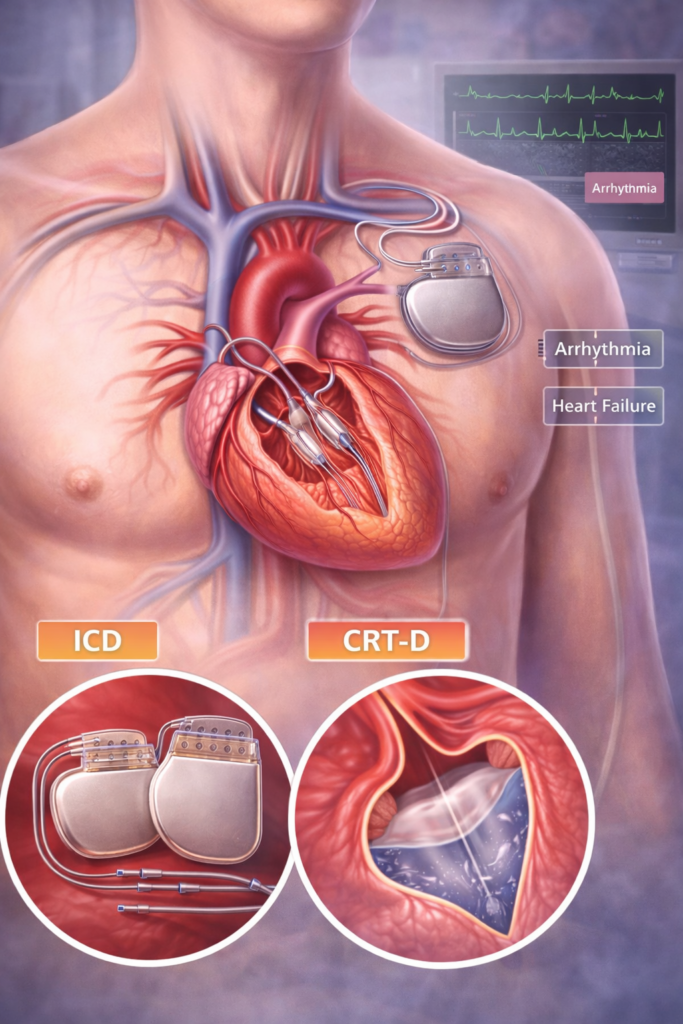
An ICD is a device designed to protect patients from sudden cardiac death caused by dangerous fast heart rhythms — specifically ventricular tachycardia (VT) and ventricular fibrillation (VF). These arrhythmias can cause the heart to quiver rather than pump effectively, leading to loss of consciousness and death within minutes if not treated.
The ICD continuously monitors the heart rhythm. If a life-threatening rhythm is detected, it delivers a precisely timed electrical shock — a defibrillation — to reset the heart back to a normal rhythm. It can also provide pacing for bradycardia (slow heart rate) if needed.
- Who Needs an ICD?
- Patients who have survived a cardiac arrest or an episode of sustained ventricular tachycardia
- Patients with significantly reduced heart function (ejection fraction below 35%) due to heart failure or previous heart attack — who are at high risk of sudden cardiac death
- Patients with inherited conditions associated with sudden cardiac death — such as hypertrophic cardiomyopathy, long QT syndrome, or Brugada syndrome
- Patients with a prior history of serious ventricular arrhythmia
CRT-D — Cardiac Resynchronisation Therapy Defibrillator
In heart failure, the left and right ventricles of the heart often lose their normal synchrony — they stop contracting in a coordinated way, which further reduces the heart’s pumping efficiency. This dyssynchrony is often visible on an ECG as a bundle branch block pattern.
A CRT-D device uses three leads — one in the right atrium, one in the right ventricle, and one on the left ventricle — to deliver coordinated electrical impulses that resynchronise the contractions of both ventricles. This dramatically improves the heart’s pumping efficiency and is one of the most effective treatments available for appropriately selected heart failure patients.
The defibrillator component of the CRT-D simultaneously provides protection against life-threatening ventricular arrhythmias.
- Who Needs a CRT-D?
- Patients with heart failure and a significantly reduced ejection fraction (below 35%)
- Patients with a wide QRS complex on ECG — indicating electrical dyssynchrony between the ventricles (typically a left bundle branch block)
- Patients who remain symptomatic despite optimal medical therapy for heart failure
- Patients who also require protection from sudden cardiac death (combined CRT-D rather than CRT-P)
What to Expect — The Procedure
ICD and CRT-D implantation is performed under local anaesthesia with sedation. The procedure is similar to pacemaker implantation — leads are guided through a vein into the heart, and the device generator is placed in a small pocket beneath the skin below the collarbone.
CRT-D implantation is technically more complex than a standard pacemaker or ICD, as the left ventricular lead must be positioned precisely in a branch of the coronary sinus. The procedure typically takes 90 minutes to 3 hours depending on anatomy and complexity. Hospital stay is usually 2 to 3 days.
Location — Where Are ICD and CRT-D Devices Implanted?
Apollo CVHF Heart Institute
- +91 7096 800 800
- Pakwan Cross Road, Sarkhej - Gandhinagar Hwy, opp. GNFC Tower, next to l.O.C petrol pump, Bodakdev, Ahmedabad, Gujarat 380059
- Angiography, Angioplasty, Pacemakers & Devices (ICD, CRT-D), Structural Heart Procedures (ASD/VSD/PDA Closure, TAVI), Complex Coronary Work (LMCA, Bifurcations, IVL, Rotablation)
- Open 24 hours
Dr. Kulin Sheth's Approach
Dr. Sheth is known for a calm, thorough, and patient-centred consultation style. He takes time to listen, never rushes through an appointment, and explains findings clearly so that patients leave with a genuine understanding of their heart health and what needs to be done — if anything.
Patients also appreciate that Dr. Sheth only recommends investigations that are genuinely needed. There are no unnecessary tests, no unnecessary procedures, and no unnecessary alarm.