
Heart Valve Treatment Without Open-Heart Surgery in Ahmedabad TAVI & BMV at Apollo CVHF
Being told you need heart valve treatment can be frightening, particularly when surgery is mentioned. The good news is that for many patients with heart valve disease today, open-heart surgery is no longer the only option.
Using advanced catheter-based heart valve treatment technology, Dr. Kulin Sheth, an experienced Interventional Cardiologist in Ahmedabad, treats two of the most common heart valve conditions – aortic valve stenosis and mitral valve stenosis- without opening the chest, without stopping the heart, and without a lengthy hospital stay. These minimally invasive procedures are performed at Apollo CVHF Heart Institute, Bodakdev, Ahmedabad, providing advanced cardiac care with faster recovery for eligible patients.
TAVI Transcatheter Aortic Valve Implantation
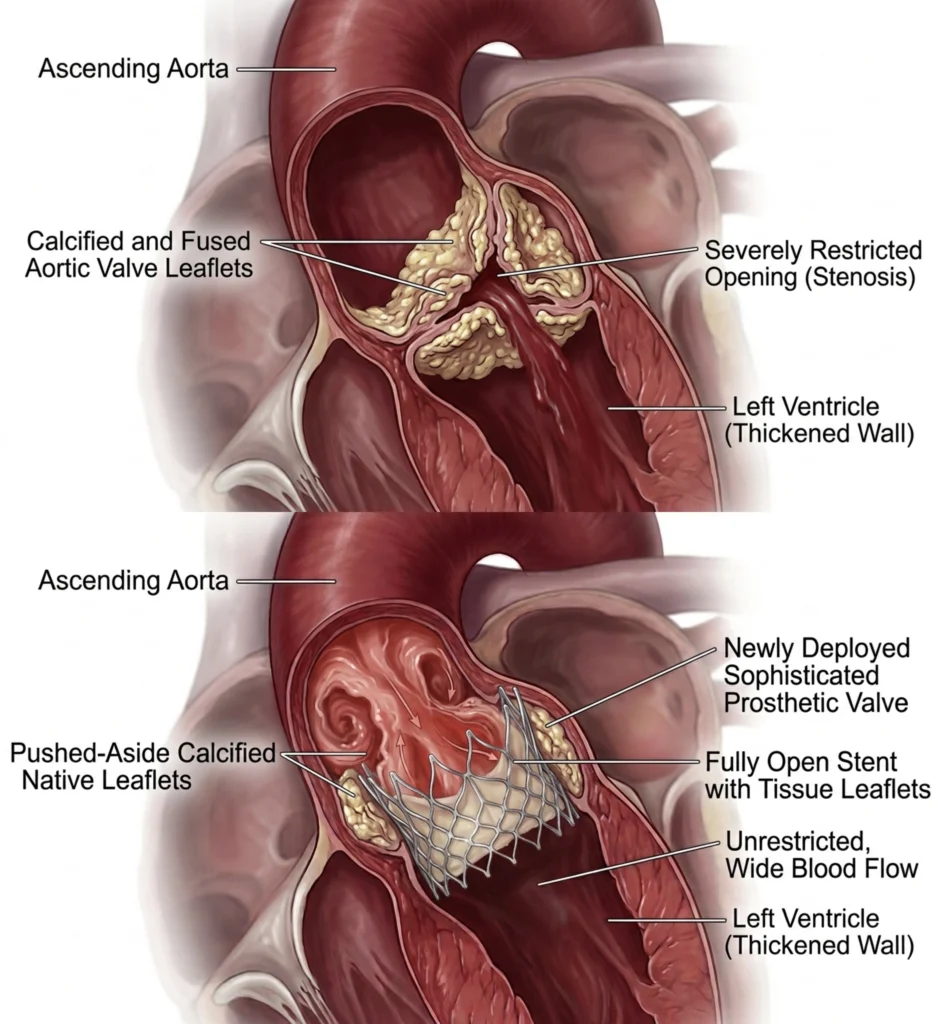
TAVI (also called TAVR, Transcatheter Aortic Valve Replacement) is a procedure used to replace a severely narrowed aortic valve, a condition called aortic stenosis, without open-heart surgery.
The aortic valve controls blood flow from the heart to the rest of the body. When it becomes severely narrowed, the heart has to work much harder to pump blood through the restricted opening. This causes progressive symptoms of breathlessness, chest pain, dizziness, and fainting and, if left untreated, carries a very poor prognosis.
How Is TAVI Performed?
- During TAVI, a new replacement valve is compressed onto a catheter and delivered through the femoral artery in the groin without any incision in the chest. Under X-ray and echocardiographic guidance, the new valve is positioned precisely within the diseased native valve and expanded, immediately restoring normal blood flow. The diseased valve leaflets are pushed aside, and the new valve takes over.
Who Is TAVI For?
- Patients with severe symptomatic aortic stenosis who are at high or intermediate surgical risk where open valve replacement surgery carries a significant risk of complications
- Elderly patients typically above 70 to 75 years for whom TAVI offers excellent outcomes with a much lower procedural burden than surgery
- Patients who have previously undergone surgical aortic valve replacement whose bioprosthetic valve has degenerated a procedure called 'valve-in-valve' TAVI
- Selected younger, lower-risk patients based on shared decision-making and a detailed Heart Team discussion
What to Expect
TAVI is performed under local anaesthesia or light general anaesthesia. Most patients are discharged within 3 to 5 days. The improvement in symptoms, breathlessness, energy levels, and exercise tolerance is often dramatic and noticed within the first few weeks after the procedure.
BMV Balloon Mitral Valvotomy
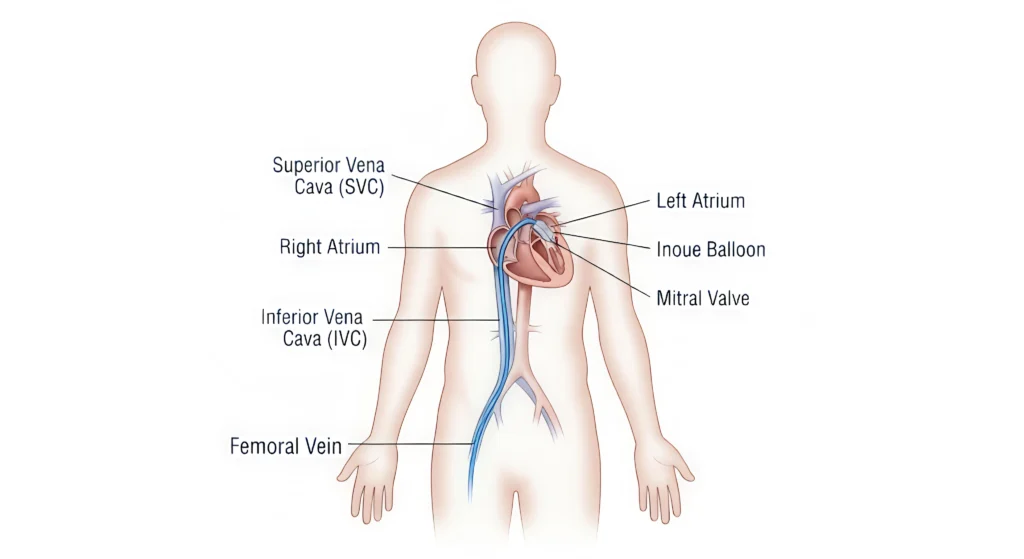
Balloon Mitral Valvotomy (BMV) is a catheter-based procedure used to treat mitral stenosis, a narrowing of the mitral valve, most commonly caused by rheumatic heart disease. Rheumatic mitral stenosis remains prevalent in India and is a significant cause of heart failure and disability, particularly in younger patients.
In mitral stenosis, the mitral valve leaflets become thickened, fused at their edges, and progressively narrowed, restricting blood flow from the upper left chamber (left atrium) to the lower left chamber (left ventricle). This causes breathlessness, fatigue, palpitations, and, in advanced cases, severe pulmonary hypertension and heart failure.
How Is BMV Performed?
During BMV, a catheter is guided through the femoral vein in the groin, across the interatrial septum (the wall between the two upper chambers), to the mitral valve. A specially designed balloon is then inflated within the narrowed valve, separating the fused leaflets and widening the valve opening, immediately improving blood flow from the left atrium to the left ventricle.
Who Is BMV For?
- Patients with significant symptomatic mitral stenosis breathlessness, reduced exercise tolerance, palpitations
- Patients with suitable valve anatomy on echocardiography, pliable, non-calcified leaflets with no significant mitral regurgitation
- Patients who are pregnant and developing haemodynamic compromise from mitral stenosis: BMV can be performed safely during pregnancy
- Younger patients with rheumatic mitral stenosis, in whom BMV offers an effective treatment that delays or avoids the need for valve replacement surgery
What to Expect
Location: Where Are TAVI and BMV Performed?

Apollo CVHF Heart Hospital
- +91 7096 800 800
- Pakwan Cross Road, Sarkhej - Gandhinagar Hwy, opp. GNFC Tower, next to l.O.C petrol pump, Bodakdev, Ahmedabad, Gujarat 380059
- Angiography, Angioplasty, Pacemakers & Devices (ICD, CRT-D), Structural Heart Procedures (ASD/VSD/PDA Closure, TAVI), Complex Coronary Work (LMCA, Bifurcations, IVL, Rotablation)
- Open 24 hours
Dr. Kulin Sheth's Approach
Dr. Sheth is known for a calm, thorough, and patient-centred consultation style. He takes time to listen, never rushes through an appointment, and explains findings clearly so that patients leave with a genuine understanding of their heart health and what needs to be done, if anything.
Patients also appreciate that Dr. Sheth only recommends investigations that are genuinely needed. There are no unnecessary tests, no unnecessary procedures, and no unnecessary alarm.
Valve Disease Doesn't Always Mean Open Surgery
FAQs
Structural heart disease refers to wear, defects, or abnormalities within the heart’s valves, walls, or chambers rather than blockages in the coronary arteries. Dr. Kulin Sheth specializes in advanced, minimally invasive structural heart interventions at specialized catheterization laboratories in Ahmedabad. His primary focus is on transcatheter techniques-such as TAVI/TAVR and BMV-which allow for the repair or replacement of diseased heart valves without the need for traditional open-heart surgery.
Transcatheter Aortic Valve Implantation (TAVI)-also known as TAVR (Transcatheter Aortic Valve Replacement)-is a highly specialized, non-surgical treatment for severe aortic valve stenosis (narrowing of the aortic valve). Dr. Kulin Sheth recommends TAVI primarily for elderly individuals, frail patients, or those with significant comorbidities (such as chronic kidney disease or severe lung disease) who face high risk if subjected to traditional open-chest surgical valve replacement. During the procedure, a fully collapsible replacement valve is guided through a small puncture in the groin (femoral artery) and deployed directly inside the diseased valve to instantly restore normal blood flow.
A Balloon Mitral Valvotomy (BMV)-also clinically termed Percutaneous Transvenous Mitral Commissurotomy (PTMC)-is a catheter-based procedure used to open a severely narrowed mitral valve, a condition frequently caused by rheumatic heart disease. Dr. Kulin Sheth advances a specialized balloon-tipped catheter through the femoral vein up into the heart. The balloon is precisely positioned across the fused leaflets of the narrowed mitral valve and briefly inflated, cracking open the restriction and expanding the valve area to relieve severe shortness of breath and fluid accumulation in the lungs.
Compared to traditional open-heart surgery, transcatheter structural procedures such as TAVI and BMV offer substantial clinical benefits:
No Sternotomy Required: The patient’s chest cavity is not surgically opened, and the heart is not stopped.
Accelerated Recovery: Due to the use of localized, minimally invasive vascular access, hospital stays are typically reduced to just 1 to 3 days.
Lower Procedural Complications: There is less post-operative pain, minimized bleeding risk, and a significantly faster return to baseline daily activities.
As an experienced interventional cardiologist specializing in advanced structural heart interventions, Dr. Kulin Sheth provides comprehensive, patient-centered evaluations for complex valve diseases. His diagnostic protocol includes precision 3D Echocardiography and dedicated CT structural planning to assess anatomic eligibility for TAVI or BMV. His clinical approach focuses on offering viable, minimally invasive treatment alternatives for patients who have been deemed unsuitable for or are seeking an alternative to conventional open-chest surgery.